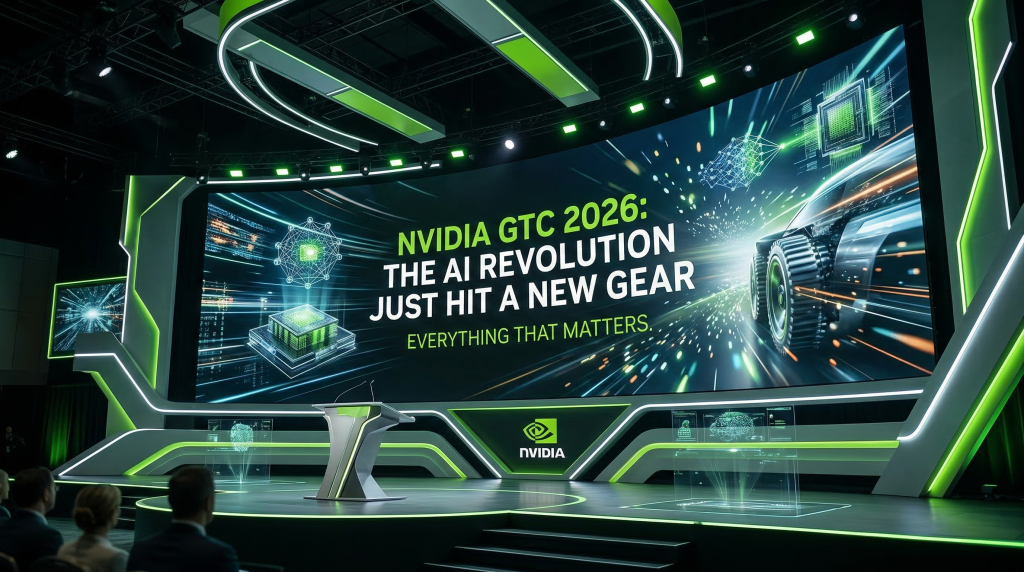
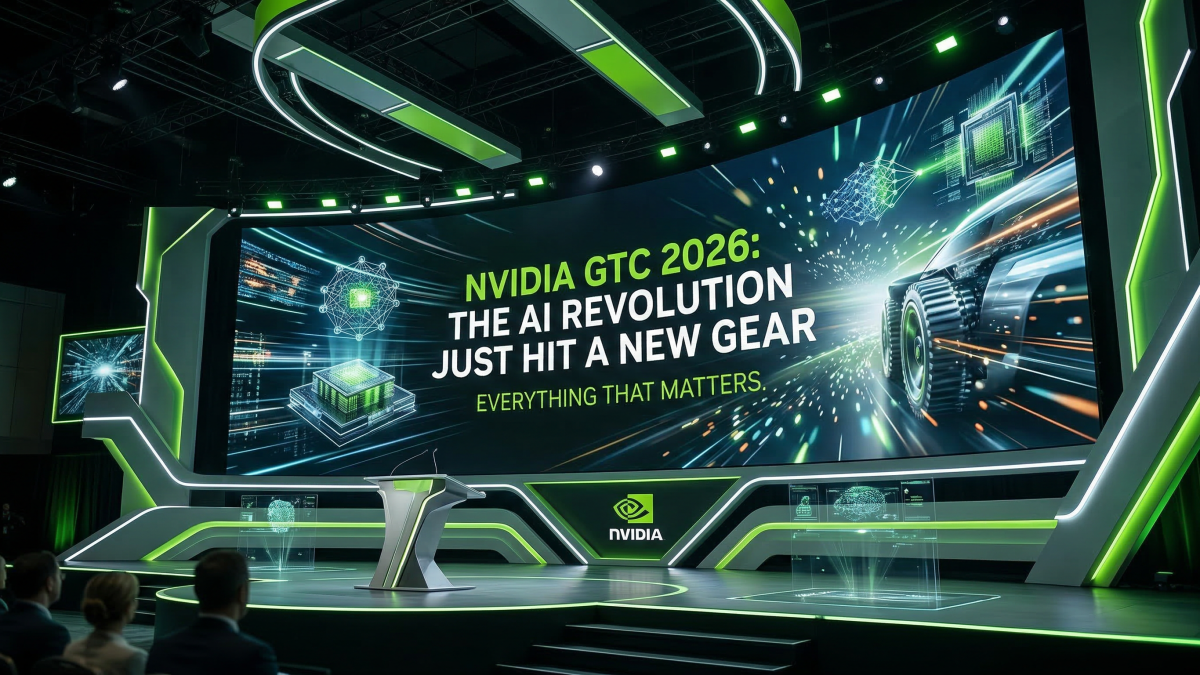
The AI Revolution Just Hit a New Gear — Here’s Everything That Matters From NVIDIA GTC 2026
From smarter graphics to AI agents that run on your own machine — NVIDIA’s annual tech conference just mapped out the next two years of AI, and it’s moving faster than anyone expected.
If you’ve ever felt like AI is advancing faster than you can keep up — you’re not alone. But don’t stress. NVIDIA’s GTC 2026 conference, held in San Jose from 16–19 March, actually gave us a clearer picture of where this technology is heading and, more importantly, what it means for everyday creators, businesses, and industries right here in Australia.
CEO Jensen Huang took the stage to a crowd that’s been dubbed the “Woodstock of AI” — and he didn’t disappoint. Here are the five things that actually matter from GTC 2026, broken down in plain English.
1. Vera Rubin: The AI Factory That Will Make AI Way Cheaper
If you’ve ever grumbled about the cost of running AI tools or generating video content, Vera Rubin is the answer. NVIDIA’s next-generation data centre platform — named after the pioneering astronomer — is a fully integrated “AI factory in a box.” It combines the new Vera CPU, the Rubin GPU, and an entire rack-scale system designed from the ground up for the kind of heavy, agentic AI workloads that are becoming the norm across every industry.
The headline number? 10x more inference throughput per watt at one-tenth the cost per token. In plain English: the same AI outputs that cost $10 today will cost $1 tomorrow — and they’ll be delivered faster. For anyone using AI tools for creative production, video generation, or data processing, this is massive news.
📊 Industry Signal
Vera Rubin is already attracting $1 trillion in orders through to 2027, signalling that the entire industry is betting big on this platform. NVIDIA has also teased the Feynman architecture — the generation that follows Vera Rubin — featuring the Rosa CPU and a next-gen Liquid Processing Unit.
The roadmap is clear: NVIDIA is building an end-to-end AI platform, not just selling chips. And that infrastructure trickles down directly to the tools you use every day.
2. NemoClaw: Your Personal AI Agent Has Arrived
One of the most exciting — and practical — announcements at GTC was NemoClaw. Think of it as NVIDIA’s open-source spin on OpenClaw, the most widely used agentic AI framework. Jensen described OpenClaw as the “open-sourced operating system of agentic computers,” and NemoClaw is NVIDIA’s powerful contribution to that ecosystem.
What makes NemoClaw genuinely exciting is how dead easy it is to get started: one terminal command and you’re up and running. It’s powered by NVIDIA’s Nemotron models (Nano, Super, and Ultra), and it’s designed to run locally — meaning your data stays on your own machine, not some distant cloud server. Think of it as your own private Jarvis, without the privacy trade-offs.
⚠️ Heads Up
NemoClaw is still an alpha release and not production-ready yet. That said, teams across media, finance, and smart cities are already building on it. It’s one to watch very closely.
In the media and entertainment session at GTC, a standout use case emerged: a multi-agent creative pipeline where one “prompt expert” agent parses and enriches a creative brief, then hands off to specialised sub-agents focused on composition, storyboarding, and content generation. There’s also a new collaboration announced between NVIDIA and Adobe for secure agentic creative workflows — a combination that could genuinely reshape production pipelines in the near future.
3. DLSS 5: The “GPT Moment” for Real-Time Graphics
DLSS 5 is NVIDIA’s biggest graphics leap since real-time ray tracing debuted back in 2018. At its core, it uses 3D-guided neural rendering and generative AI to produce photorealistic 4K visuals in real time — with materials and lighting that are practically indistinguishable from reality. The kicker? It does this using significantly less computing power than traditional rendering approaches.
Think of it like running a high-end AI upscaler (similar to Topaz or Magnific) directly inside the game or rendering engine — in real time. For filmmakers, animators, and game developers, this changes the cost and time equation for high-fidelity visual production in a fundamental way. DLSS 5 is set to launch in the latter part of 2026.
🎮 Community Note
There’s been some community debate around DLSS 5 altering certain character rendering characteristics — giving visuals an overly “cinematic” look. NVIDIA is addressing this feedback, and the full picture will become clearer once it hits production releases. The conditions under which this occurs haven’t been fully confirmed yet.
Complementing DLSS 5, the GTC session on Neural Rendering introduced Neural Texture Compression (NTC) and SlangPy — a shader rendering tool that uses neural processing at the pixel level. Together, these technologies represent a new era in how graphics pipelines are built: less brute-force computation, more intelligent inference at every stage.
4. AI Is Reshaping Creative Industries — and Music Is Leading the Charge
One of the most thought-provoking sessions at GTC featured Sir Lucian Grainge, Chairman and CEO of Universal Music Group, in conversation with NVIDIA’s Richard Kerris (former CTO of Lucasfilm). The central message? AI isn’t here to replace artists — it’s here to amplify them.
Grainge’s vision is grounded: back the talent, invest in creativity, and use AI as a tool for distribution, discovery, and connection — not a shortcut that erodes an artist’s identity. UMG has been purchasing significant music catalogues (including works tied to The Beatles, ABBA, and Amy Winehouse) to help monetise and preserve them responsibly into the future. Critically, AI has been used to remaster these works — not to recreate or replace the artists behind them.
🎵 On Guardrails
“Artist work stays their work.” Taylor Swift’s voice, for example, only appears in her own catalogue — it’s not available for another artist to use as their own. This is the kind of guardrail that gives the creative community confidence to lean in.
The broader theme running through the media and entertainment track was one of empowerment. Agentic AI systems are now being used in real production pipelines to automate the repetitive parts of creative work — freeing artists to focus on the craft itself. New genres will still emerge (just as K-Pop and BTS changed the global music landscape), and the tools being built right now are designed to help those new voices reach audiences faster and more directly than ever before.
5. Agentic AI Is Going to Work — Across Every Industry
Two sessions at GTC stood out for demonstrating just how broadly agentic AI is being deployed across sectors that might not immediately come to mind.
In finance, Sweden’s SEB Bank presented an impressive agentic system built with NVIDIA NeMo and multi-modal RAG (Retrieval-Augmented Generation). The system pulls from both internal proprietary data and external web sources to produce sophisticated client reports, identify opportunities before they appear, and support complex financial forecasting — all with a sovereign AI architecture that keeps sensitive data on-premises.
In smart cities, company K2K demonstrated how Vision-Language Models (VLMs) integrated with NVIDIA Cosmos Reason are turning passive urban surveillance footage into active, real-time intelligence. The system processes multi-modal data streams — video, weather, traffic — through a single pipeline, and intelligently redacts biometric data for general users while preserving full access for authorised forensic use.
💡 The Big Picture
The thread connecting these sessions: the shift from AI as a query tool to AI as a proactive agent. It’s not just answering questions anymore — it’s anticipating problems and taking action.
The Takeaway: This Is the Moment to Lean In
GTC 2026 wasn’t just a product launch event — it was a signal that the infrastructure for a genuinely AI-native world is now being built at scale. Whether you’re a creator, a business leader, a developer, or just someone trying to stay informed, the message from San Jose was clear: this is the moment to get curious, get involved, and lean into the technology.
The tools are getting cheaper, faster, and more accessible. The frameworks are going open source. The creative industries are finding their footing with guardrails that protect artists. And the infrastructure being built today will power the AI experiences we’ll all be using in 12–24 months.
The future isn’t something that’s happening to us — it’s something we get to build. And right now, the building materials have never been better.