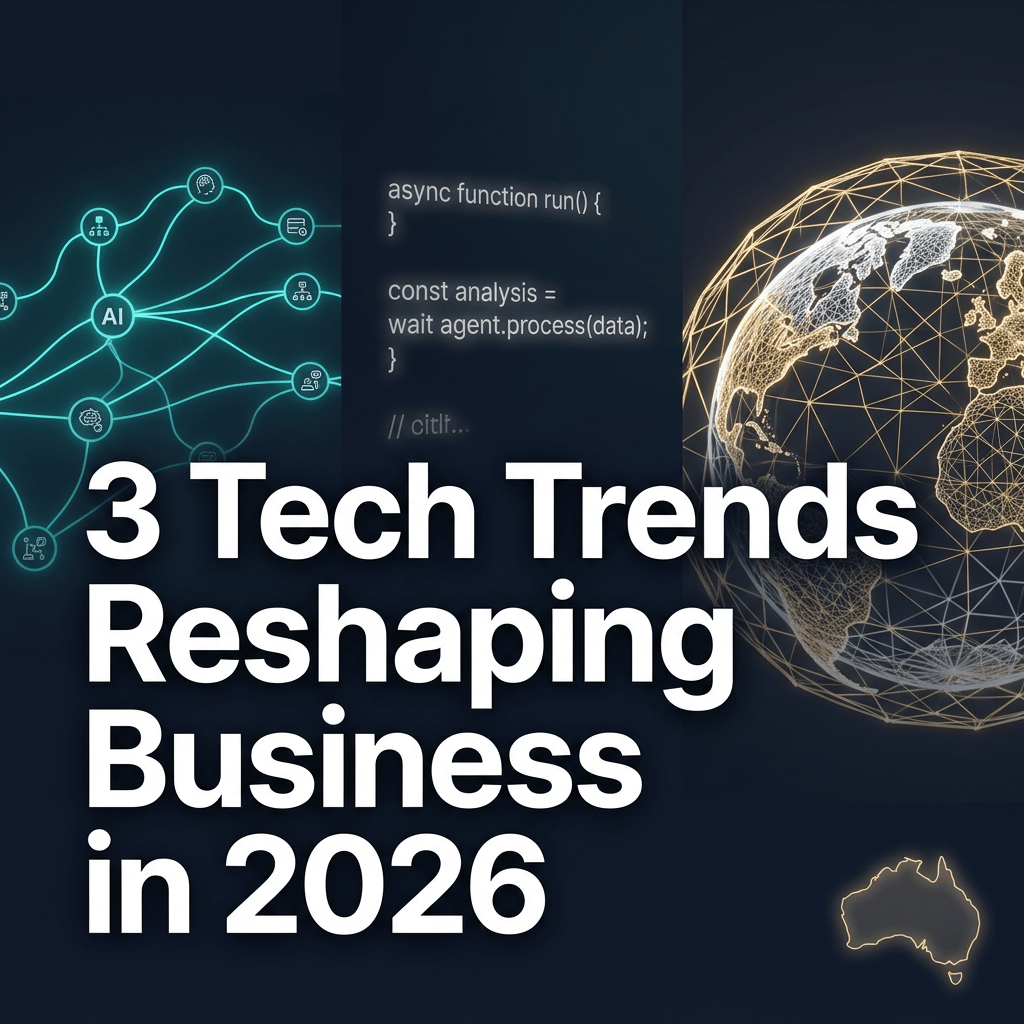
Three Technology Shifts Every Founder Needs to Understand Right Now
We are living through one of the most compressed periods of technological change in history. For founders and CEOs of growth businesses in Australia — particularly those in health and wellbeing, finance, and education — three converging trends are reshaping how products are built, how teams operate, and how entirely new experiences come to life.
Understanding them is no longer optional.
⚙️ 1. Agentic Workflows — Your Business Runs While You Sleep
Forget basic automation. Agentic AI is a step change — multi-step, autonomous systems that make decisions, execute tasks, and loop back for review with minimal human intervention. Think of it as moving from a calculator to a colleague.
The numbers are compelling. Research from the Harvard Data Science Review shows that organisations that redesign workflows with agentic AI are achieving 2–10x productivity gains. The global Agentic AI Workflows market is projected to reach USD $227 billion by 2034. In real terms, businesses are seeing 25–40% reductions in operational costs through intelligent process automation.
For a health startup managing patient intake, an EdTech platform personalising learning paths, or a fintech firm processing compliance workflows — agents don’t just save time, they unlock scale that was previously impossible without a large team.
💻 2. Vibe Coding — Building Products at the Speed of an Idea
Popularised by Andrej Karpathy (former Tesla AI Director and OpenAI founding member), vibe coding describes the practice of building software through intuition and AI-assisted generation — less syntax, more intent. You describe what you want to build, and the AI builds it.
The adoption curve is extraordinary. The global vibe coding market is currently at $4.7 billion and is projected to reach $12.3 billion by 2027. Remarkably, 21% of Y Combinator Winter 2025 startups now have codebases that are 91% AI-generated. For non-technical founders in education or wellness, this is genuinely democratising — MVPs, internal tools, client dashboards, and automations that once needed a $150K developer budget can now be prototyped in days.
🌐 3. The Rise of 3D and World Builders — Designing the Experiences of Tomorrow
We are entering an era in which the boundary between the digital and the physical continues to blur. AI-powered 3D design tools, spatial computing platforms, and real-time world builders are enabling teams to create immersive product experiences, virtual training environments, interactive health journeys, and financial data visualisations that were previously the exclusive domain of game studios and film production houses.
The 3D design software market is growing at a compound annual rate exceeding 15% through 2030, with AI-driven tools enabling text-to-3D workflows that compress weeks of design work into hours. Virtual prototyping alone is cutting physical sample waste by up to 90% — an enormous win for product-led health and wellness businesses.
⚠️ But Here’s the Conversation Nobody Wants to Have
The pace of adoption is creating a dangerous gap — and Australian businesses are right in the crosshairs.
New research from TrendAI™ (March 2026) reveals that 68% of Australian organisations say AI is advancing faster than they can secure it, while 44% of senior business decision-makers admit to only a moderate understanding of the legal frameworks governing AI use. Globally, 54% of surveyed businesses acknowledge they adopted AI too quickly and are now scrambling to course-correct.
The unsexy — but absolutely mission-critical — parts of any system are being systematically undercooked:
-
Security — shadow AI tools, prompt injection attacks, and data leakage into unreviewed third-party platforms
-
Governance — unclear accountability chains when an AI agent makes a consequential decision
-
Privacy and permission controls — in 2025, an Australian contractor uploaded personal health records, including names and contact details, into an unsanctioned AI tool, resulting in a notifiable data breach
In regulated industries like finance, healthcare, and education, the consequences of getting this wrong aren’t a minor setback — they can be existential. Australia’s Cyber Security Centre has published specific guidance for small businesses on AI risk, and the message is clear: build the governance architecture before you need it, not after the incident.
The founders winning in the long term are not just the fastest adopters. They are the ones building on solid foundations — with data classification policies, AI use frameworks, vendor due diligence, and permission architectures baked in from day one.
Move fast. But build right.
What’s your experience with these trends? Are you building governance frameworks alongside your AI stack, or does that feel like a problem for tomorrow? I’d love to hear from fellow founders in the comments.
Sources behind this post:
-
Harvard Data Science Review — Agent-Centric Enterprise Productivity Research
-
TrendAI™ Australian AI Governance Report, March 2026
-
Second Talent / Taskade — State of Vibe Coding 2026
-
Style3D — Latest Trends in 3D Design 2026
-
Australian Cyber Security Centre — AI for Small Business
-
ISMS.online — AI Governance Challenges 2026
-
Agentic AI Workflows Market Report, March 2026